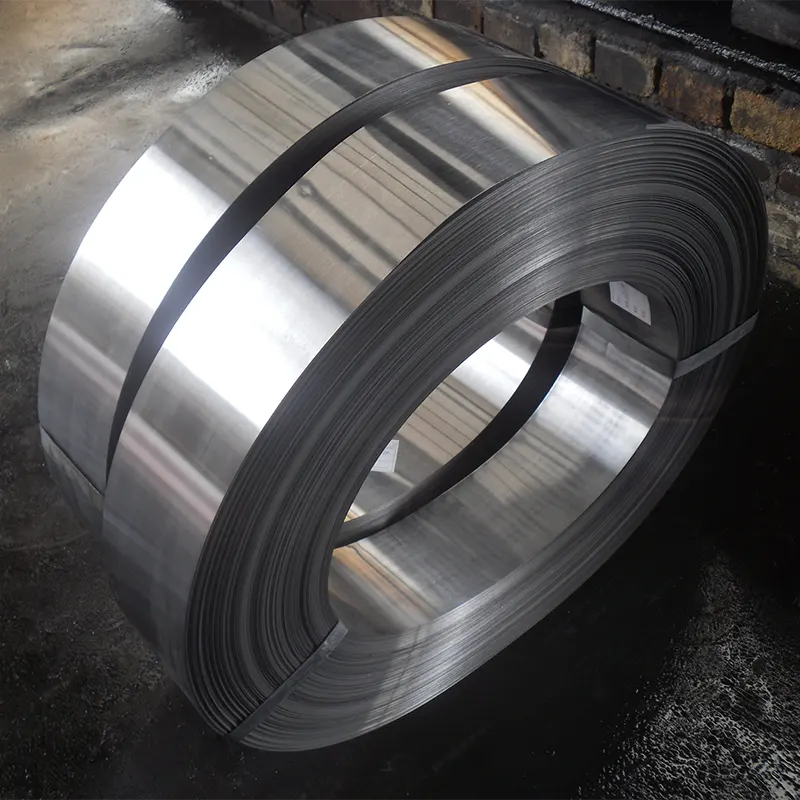
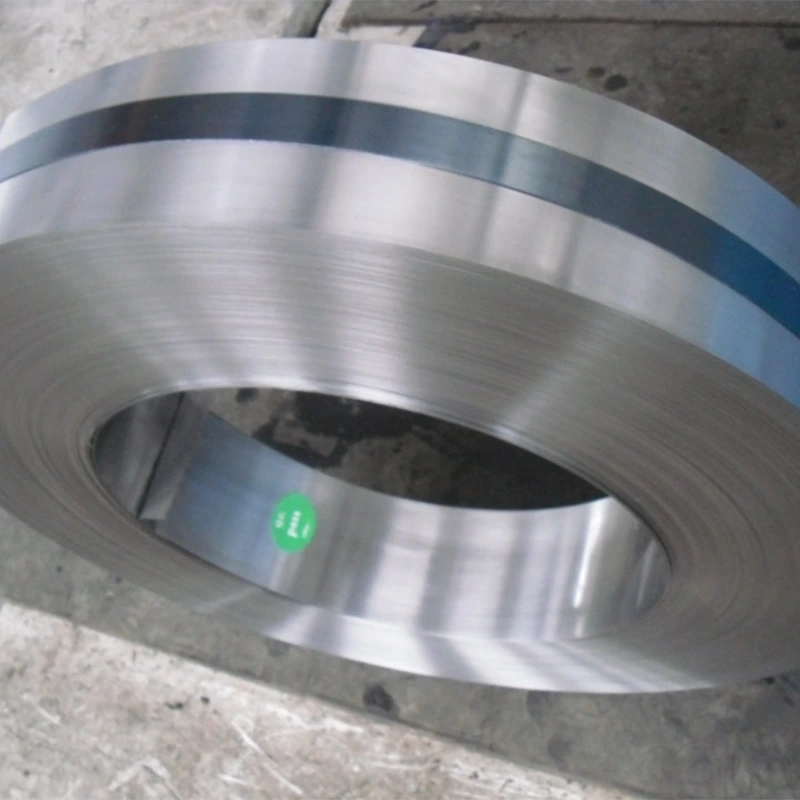
Quick Comparison: SUS304 vs SUS301 at a Glance
| Comparison | SUS304 Stainless Steel Strip | SUS301 Stainless Steel Strip |
|---|---|---|
| Typical Composition (Cr / Ni / C) | 18–20% / 8–10.5% / ≤0.08% | 16–18% / 6–8% / ≤0.15% |
| Annealed Tensile Strength | ≥520 MPa | ≥520 MPa |
| Max Tensile Strength after Cold Rolling | ~1180 MPa (conventional processing window) | 1300–1500 MPa+ (depending on temper) |
| Work-Hardening Tendency | Moderate; intermediate annealing required | Very high; ~14 MPa per 1% cold reduction |
| Corrosion Resistance | Superior; PREN ~20 | Slightly lower; PREN ~18; higher welding sensitization risk |
| Food-Contact Suitability | Specified for more than half of foodservice products | Used in sinks, cookware, etc., but prone to cracking under severe forming |
| Typical Core Applications | Chemical equipment, food machinery, deep-drawn parts, welded structures | Springs, spring contacts, precision elastic components, high-strength structural parts |
1. Basic Positioning: Both Are 300-Series Austenitic, but with Different “Design Intent”
SUS304 and SUS301 are both austenitic stainless steels under the JIS system. SUS304 is the 18Cr-8Ni “baseline grade,” pursuing a balance among corrosion resistance, formability, and weldability. SUS301 has a nominal composition of 17Cr-7Ni with carbon allowed up to 0.15%; both chromium and nickel are lower than 304. This composition design keeps the austenitic structure in the solution-annealed condition, but during cold working it undergoes significant strain-induced martensite transformation, enabling a far greater strength increase than 304.
In other words, SUS304’s alloy design serves “long-term stable service in corrosive environments,” while SUS301’s alloy design serves “pushing strength as high as possible through cold rolling.”
2. Chemical Composition and Mechanical Property Differences
Chemical Composition
Under JIS standards, the composition ranges are as follows:
| Element | SUS304 | SUS301 |
|---|---|---|
| C | ≤0.08% | ≤0.15% |
| Cr | 18.00–20.00% | 16.00–18.00% |
| Ni | 8.00–10.50% | 6.00–8.00% |
301’s higher carbon content and lower chromium and nickel content are the root cause of all subsequent performance differences: carbon provides interstitial solid-solution strengthening and promotes martensite transformation during cold working, but higher carbon also increases the risk of welding sensitization (grain-boundary chromium carbide precipitation); lower chromium content directly compresses the stability margin of the passive film.
Mechanical Properties
In the annealed condition, the two are not significantly different: both SUS304 and SUS301 have yield strength ≥205 MPa, tensile strength ≥520 MPa, and elongation ≥40%. The real watershed appears in the cold-rolled condition.
SUS301’s work-hardening rate is approximately 14 MPa per 1% cold reduction, far higher than SUS304. This allows 301 strip to be cold-rolled from the annealed 520 MPa to over 1500 MPa (SH temper), with hardness rising from HV 200 to above HV 550. For reference, 304’s tensile strength upper limit in conventional cold-working windows is typically reported around 1180 MPa, while full-hard 301 can reach approximately 1460 MPa. In the 3/4 Hard to Full Hard range required for springs and elastic components, 304’s achievable strength space is far less than that of 301.
3. Corrosion Resistance: A Systematic Advantage for 304
SUS304 offers “excellent”-level corrosion resistance in most chemical and food environments, but is subject to pitting and crevice corrosion in chloride-containing media, and stress corrosion cracking can occur above 60°C. Its corrosion-resistance boundary is: good performance in oxidizing acids (such as nitric acid), but not suitable for high-chloride conditions.
SUS301’s corrosion resistance is “slightly lower than 304,” directly because of its lower chromium content—the passive film’s self-repair capability and stability in corrosive media are reduced. PREN (Pitting Resistance Equivalent Number) estimates confirm this gap: 304 is approximately 20, 301 approximately 18. More importantly, 301’s higher carbon content makes the weld heat-affected zone prone to chromium carbide grain-boundary precipitation, leading to chromium depletion near grain boundaries and preferential intergranular corrosion in corrosive environments. This means 301’s corrosion resistance in welded structures is not only “lower” but may suffer severe localized degradation at welded joints.
For chloride-containing media, acidic cleaning agents, or high-temperature acidic food conditions common in chemical equipment, 304’s corrosion margin is typically insufficient—316L is the more appropriate choice; 301 should not be used as a “corrosion-resistant substitute” for 304 in such scenarios.
4. Trade-offs in Hardness, Strength, and Processability
Strength and Hardness
301’s core competitiveness lies in the high-strength range. In the annealed condition the two are similar, but once the cold-rolling hardening path is entered, 301’s achievable strength and hardness limits are significantly higher than 304’s. For parts whose primary functional requirements are elastic recovery, fatigue resistance, and wear resistance (spring contacts, springs, precision connectors), 301 is the more direct material choice.
Formability
The flip side of the strength advantage is a narrowed forming window. 301’s work-hardening rate is far higher than 304’s, deformation resistance during stamping and bending is greater, and cracking risk under severe forming is higher. SUS304’s higher nickel content stabilizes austenite more, allowing greater deformation during deep drawing and complex bending—this is why it is the dominant material for deep-drawn parts (such as cookware and tanks). 301 is suitable for simple-shaped high-strength parts, not for replacing 304 in complex cold-forming operations.
Weldability
304 has good weldability and is compatible with conventional methods. The main issue with 301 welding is the sensitization tendency caused by higher carbon content: the weld heat-affected zone may precipitate chromium carbides, reducing local corrosion resistance, and post-weld annealing is usually required to restore corrosion resistance. In chemical equipment or food machinery frames with extensive welding, 304’s process tolerance is significantly higher. If strength requirements genuinely call for 301 and welding is involved, the low-carbon variantSUS301L should be considered—its carbon content is reduced to ≤0.030% with nitrogen added to compensate for strength loss, significantly improving post-weld intergranular corrosion resistance.
Magnetism Introduced by Cold Working
Both 304 and 301 are non-magnetic in the annealed condition. However, after cold working, 301’s strain-induced martensite gives it pronounced ferromagnetism. For sensors, instrument components, or certain chemical measurement scenarios with non-magnetic requirements, this is an easily overlooked but directly consequential selection constraint.
5. Practical Selection in Chemical Equipment and Food Machinery
Equipamento Químico
In chemical equipment, SUS304’s role is as a “general-purpose corrosion-resistant structural material,” suitable for oxidizing acid media such as nitric acid and general organic chemical contact environments. Its limitations are equally clear: under high chloride concentrations, crevice structures, and conditions above 60°C, the risk of pitting, crevice corrosion, and stress corrosion cracking rises significantly.
SUS301’s role in chemical equipment is not as a “primary corrosion-resistant material” but as an “auxiliary high-strength functional component”: springs, clamps, fasteners, elastic supports, and other locations requiring high strength and some corrosion resistance. These parts typically do not directly endure continuous contact with strongly corrosive media, allowing 301’s strength advantage to be utilized without exposing its corrosion-resistance shortcomings on the primary corrosion path. If these high-strength parts happen to be in corrosive media, re-evaluation is needed, or upgrading to a higher-corrosion-resistance alloy system.
Food Machinery
SUS304 is the dominant material for food-contact surfaces, with more than half of foodservice products specifying 304; the 18Cr-8Ni ratio provides balanced corrosion resistance and formability against acidic foods and cleaning chemicals. The FDA lists stainless steels with chromium content ≥16% as GRAS (Generally Recognized As Safe); both 304 and 301 meet this threshold, but 304 has far richer compliance records and application experience in actual food equipment.
SUS301’s presence in food machinery is concentrated insinks, cookware, and certain food processing equipment, leveraging its higher strength and wear resistance. But the same source also explicitly notes: 301’s lower nickel content means that if forming is too severe, the cracking tendency is higher than 304’s. For large deep-drawn tanks, mixing vessel inner walls, or complex-formed contact surfaces, 304 is the more robust choice; for flat plates, simple bent parts, or non-primary-contact structural components with additional strength requirements, 301 can serve as a cost-reduction or enhancement option.
6. Selection Decision Path
The starting point for selection should not be “304 or 301” but rather answering three constraint conditions first: media corrosiveness, forming complexity, strength requirements.
Step 1: Determine whether the media poses an unacceptable corrosion risk to 301. If the part directly contacts chloride-containing media, acidic cleaning agents, high-temperature acidic foods, or requires post-weld service without annealing, rule out 301 first and evaluate between 304 and 316L. 301’s chromium content and welding sensitization characteristics leave insufficient corrosion margin under these conditions.
Step 2: Determine forming complexity. If deep drawing, large-deformation bending, or complex cold forming is involved, 304’s nickel content and austenite stability provide a wider forming window. 301 is only suitable for relatively simple formed shapes.
Step 3: Determine whether 301-grade strength is actually required. If design loads, elastic recovery, or wear requirements genuinely demand tensile strength above 1000 MPa in the cold-rolled condition, and the part shape is simple with a controllable corrosion environment, 301 is a reasonable choice. If welding is unavoidable, switch to 301L to control sensitization risk. If strength requirements can be met by increasing cross-section dimensions or using 304 in the cold-rolled condition, 304’s overall process cost is often lower.
The decision rule can be summarized as: prioritize 304 for corrosion, prioritize 301 for strength; use 301 cautiously in welded structures (unless 301L), and use 301 cautiously in complex deep drawing. 301 is not a “cheaper version” of 304 but a high-strength specialty material that trades corrosion resistance and formability for strength.
Frequently Asked Questions
Can SUS301 directly replace SUS304 for food-contact surfaces?
Not recommended as a default substitute. Although both meet the FDA’s GRAS threshold of chromium content ≥16%, 301 has slightly lower corrosion resistance and higher cracking risk under severe forming. Food-contact primary surfaces, acidic food environments, or welded components should prioritize 304; 301 can be used in specific scenarios such as sinks and simple formed parts, but must be verified case by case.
How much worse is SUS301’s corrosion resistance compared to SUS304?
The gap comes from chromium content: 301 has 16–18% Cr, 304 has 18–20% Cr, with PREN estimates of approximately 18 and 20 respectively. In mild environments the difference may not be significant, but in chloride-containing media, weld heat-affected zones, or high-temperature acidic conditions, 301’s localized corrosion risk is notably higher, especially intergranular corrosion after welding sensitization.
Why can SUS301 achieve far higher strength than SUS304?
301 has higher carbon and lower nickel, resulting in more complete strain-induced martensite transformation during cold working, with a work-hardening rate of approximately 14 MPa per 1% cold reduction. Through cold rolling, 301’s tensile strength can be raised from the annealed 520 MPa to over 1500 MPa, while 304’s strength ceiling in conventional cold-working windows is significantly lower.
When should 301 be chosen over 304 in chemical equipment?
When the part is a high-strength functional component such as a spring, clamp, spring contact, or fastener, and is not directly exposed to the primary corrosive media, 301 can leverage its strength advantage. Primary corrosion-resistant structures, piping, vessel shells, and welded frames should use 304. If high-strength parts are simultaneously in a corrosive environment, consider upgrading the alloy rather than choosing between 301 and 304.
What is the key difference between 301 and 304 in welding scenarios?
301 has higher carbon content, making the weld heat-affected zone prone to sensitization; post-weld annealing is usually required to restore corrosion resistance. 304 has lower carbon content and better weldability. If high-strength 301 must be used and welding is involved, SUS301L is the more appropriate choice, as its low-carbon design improves post-weld intergranular corrosion resistance.